
The resource crisis expands and deepens, and water remains a critical chokepoint. There’s cause for concern, but technology, sustainable policies and growing social awareness are powerful drivers that give us every reason to be hopeful.
The problem
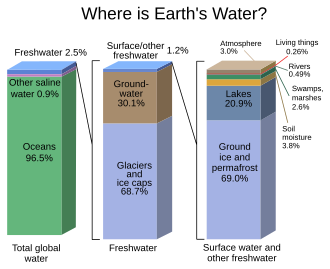
Source: ESGS via Wikipedia
All living beings need water, including us. But not all water is usable by humans, and even that fraction is getting smaller.
The data is clear: only 2.5% of all water on the planet is freshwater, and of that, most of it is trapped in ice form [Wikipedia]. Global warming, along with other consequences of anthropogenic climate change and activity (more frequent droughts and floods, widespread groundwater pollution) have put the spotlight on conservation and management of water resources.
And even then, many of us today are luckier than all of our ancestors. More people than ever enjoy the privilege of opening a tap and getting a stream of safe, clean water. But this is by no means a given: 2.1 billion people still have no access to safely managed drinking water [WHO], and freshwater resources are becoming increasingly scarce or too polluted for human uses, including agriculture. This poses an enormous challenge (environmental and social) that has to be addressed both globally and locally.
Systemic thinking, small gestures
One of the big, recurring debates in sustainability is the relative effect of small, everyday gestures by ordinary citizens: separating waste, saving energy, using public transportation, wasting less water. The cumulative effect of millions of people taking small steps to reduce their pressure on the planet’s resources is undeniably significant. Yet critics argue, correctly, that this will never be enough while current social and economic systems remain focused on a linear, extractive approach; the way of thinking that has driven human progress since the Industrial Revolution needs to be completely overhauled .
Both positions are valid, and necessary. Small, individual gestures are useful when widespread, and systemic change is crucially important. Neither will happen overnight, and mistakes will be made along the way. That’s no excuse to stay still.
“If you think education is expensive, try ignorance”, goes the adage (authorship disputed). You could say the same about sustainability: if you think the measures are inconvenient, try doing nothing. We know what happens when we do nothing. We’re living with the consequences today.
Start somewhere
Paralysis is not an option. So, what do we do? Let’s look at one symbolic, but significant, example.
The hospitality sector was among the first to apply water-saving measures that involved guests directly, by encouraging them not to request fresh towels every day. It was no doubt one of many saving measures adopted behind the scenes, but this one was public, direct and simple: a low-effort, highly visible way to save on water and energy costs: something most of us already do at home without thinking twice.
The measure was received with a mixture of irritation and tepid praise, but it’s now quite widespread, and many guests accept it without a second thought. It’s not a systemic change. It’s not going to move the needle significantly on global water availability. It’s just a first step, of course.
But it’s an important one.
It’s explicit. It’s clear. It’s easy to do, and not even particularly inconvenient. Its main value, though, isn’t how effective it is in isolation; hotels and companies have far more powerful tools at their disposal to save, reuse and recycle water, and the technology keeps improving. What a gesture like this does is raise awareness and fight paralysis. Even when paired with more ambitious approaches, social awareness is a crucial first step for making change possible and making it stick.
Social awareness matters, both for small steps and systemic changes.
Water has been taken for granted long enough
Awareness of the severity of the problem is a starting point, but it’s a bleak place to stop.
Water management in the hospitality sector has gone far beyond a polite note in the room asking guests to save water, and it will doubtless go farther still: for water, and for other environmental and social sustainability issues. But that small, seemingly trivial gesture is worth highlighting, precisely because water is so often taken for granted.
There are few places where tap water fees actually reflect the real costs of purifying and transporting it; even in semi-arid climates, tap water is, excuse the expression, dirt-cheap. That’s convenient for consumers, of course, but municipalities and governing bodies are starting to adjust policies and pricing based on water stress and availability, and public awareness about water has skyrocketed in most countries.
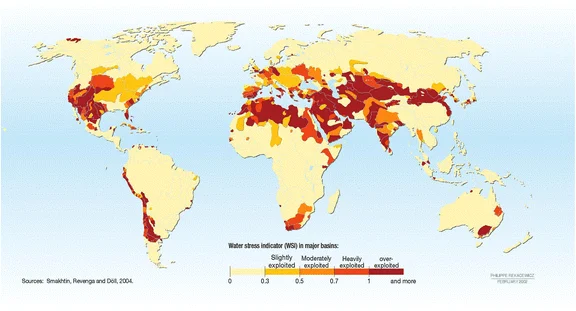
UN Water scarcity map. Source: Researchgate
These technical, political and social drivers, working in unison, will allow water to be used responsibly, safely and equitably across the planet; something that can only benefit all populations and economic sectors.
In the case of water, we know the why, we know the how, and society is willing. In cases like this, optimism isn’t naïveté: it’s the only reasonable conclusion.