
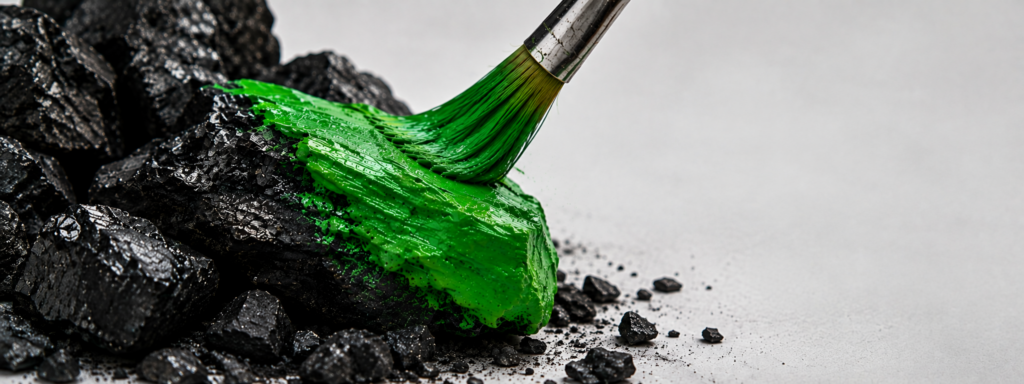
Being conscious of the environment is a good and important thing. Using the environment as a marketing ploy, throwing about empty words that have no real actions behind them, is what’s called ‘greenwashing’. And it has to stop.
We all want to be green
Environmental consciousness has been growing steadily in the last decades. Even without the many and worrying signs that the climate crisis brings to our attention, humanity has realised that we depend on the environment’s well-being to thrive. This means that words commonly associated with responsible environmental behaviour are perceived as positive and desirable: ‘green’, ‘eco’, ‘bio’, ‘sustainable’, ‘recyclable’, ‘carbon neutral’.
This is symptomatic of the paradigm change of environmental issues in society’s view: from a fringe, slightly irritating topic to a central theme in many debates.
But there is a dark side to this.
A thin coat of green paint
The positive associations of the words and phrases related to good environmental practices can happen even if there’s nothing behind those words. Besides, people want to assume that a company, especially a company they already like and trust for other reasons, is environmentally responsible; and a little cosmetic nudge may be enough to cement that perception: a green logo, a stylized leaf design, a photo of a panda. All this says ‘we care’; ‘we worry’, ‘we’re doing things right’.
But are you really?
The siren songs of performative ‘green’ communication have been growing along with environmental consciousness, and the concept of greenwashing appeared as quickly as the concept of ‘green’. Putting on a veneer of ecology on what were no more than business -as-usual decisions, or simply inserting good-sounding words in corporate reports, with no real actions behind them, became very popular among many, many companies.
Products started acquiring prefixes like ‘eco-‘ or ‘bio-‘ and adjectives like ‘green’ or ‘natural’ that seemed to indicate a drive to be more sustainable. But many of them were cosmetic, not backed by real actions, or simply communicated in a perfunctory, performative way, just to ‘look the part’.
Many of these practices emanate from a real desire to do the right thing, coupled with an incomplete understanding of what is really beneficial. But the net result is harmful: consumers deceived in this way think they are really choosing better products when they are not, and as such they do not nudge the market towards a very necessary change for the better. And trust is slowly eroded as study after study shows that these greenwashed claims have no basis in reality. Everybody loses: companies, people, the economy, the planet. Many companies are discovering that this is also a bad idea in terms both of money and reputation.
It’s not easy being green
Not falling into greenwashing is not as easy as it sounds. This is partly because everyone has come to expect environmentally responsible behaviour practically everywhere, and certainly from every business. However, environmental benefits are difficult to quantify and communicate, and even more difficult to guarantee. Besides, sometimes you look at what you thought was a good environmental claim and it can become somewhat disappointing. As an example, a sentence such as ‘New eco-packaging!’, which is greenwashing, could be corrected into something like ‘Since 2025, our packaging contains 65% of recycled material in its plastic components’. It doesn’t sound as good, does it?
Describing truthfully and accurately an environmental claim can result in clunky sentences and not-so-impressive (although real) improvements. Or it may happen that abandoning the tired ‘eco-‘ and ‘bio-‘ and ‘100% natural’ buzzwords will leave a void, because the company has done nothing really significant or, worse, it doesn’t know what to really do because they never really studied the issue. The fear of being disfavourably judged jumps to the forefront of the company’s decision-makers and the result is silence when there was greenwashing.
Scary as it may be, identifying and abandoning greenwashing altogether is a necessary step to break the circle of stagnating environmental communication.
Find the real green
It may not sound as sexy, nor as impressive. But a sustainability communication that is based on high quality data, i.e. completeness, accuracy, consistency, validity, uniqueness, timeliness and integrity, is the only way to go. Greenwashing will not get anyone anything. As a company, it pays off to invest some time in re-thinking our approach to sustainability and engage in an honest dialogue with society and our own management about the real environmental and social performance of a company.
What’s it look like, then? Here’s a short and very non-comprehensive guide to avoid greenwashing:
- Say it all, not just the pretty bits: if you have recycled content but it’s only part of the packaging, say it! It’s good that you have at least that and you’ll hopefully be increasing the amount in time, so give your audience a baseline to improve upon.
- Be precise: vague sentences like ‘we reduced water usage’ help nobody and look like you’re hiding something. How much water, in what period, how much is that compared to previous years? Even a small improvement is really good, especially if you can back it up with solid data.
- Be consistent: if you report on a set of issues, keep reporting consistently on those issues even as you add new ones or make improvements in your methodology. If you decide to stop reporting on something, explain clearly why.
- Provide time frames, especially for targets and milestones: ‘We have reduced 100 tons of plastic’ sounds great, but the period in which you achieved that is very important too! If you have a specific target don’t just talk about what you will accomplish; also talk about when you’ll do it.
- Follow through: if you have communicated a plan or a target, don’t forget it as soon as it’s published. Communicate milestones and targets. You can change dates and timelines, as long as you say you’re doing it and explain why. The key here is to be predictable. Say what you’re going to do, then do it, or explain what happened when you don’t.
Keep the green, discard the washing
Sounds scary? It’s really not. An honest, complete disclosure of where you are and what you’re doing to improve management of social and environmental aspects can only be beneficial. It conveys predictability, responsibility and consistency. Slight dips in environmental trends may look bad but the subsequent correction says much more about the company’s responsibility and sustainability than any flowery logo.
As legal requirements tighten the definition of what constitutes good sustainability communication, training ourselves to be aware of greenwashing pitfalls and adjusting our strategies to weed them out is a win-win strategy: customers get truthful and relevant information and companies focus on the real issues with a clear vision of things as they are, not as we’d like them to be.