
Sustainability is not just the environmental part of it, and the environmental part of sustainability is not just CO2. Opening the scope can help fight paralysis and broadens the field of improvements and decisions we can all participate in.
You have carbon tunnel vision
So do I. So do most of us that work in sustainability. When GHG emissions, with its direct effect on global warming, are so present in the news and the collective mind, it’s perfectly logical to ‘think carbon’ all the time. In fact, it is a good thing.
GHG emissions are the big challenge of our time: they lie at the root of most of the current environmental and social problems humanity faces. The consequences are varied, complicated and ubiquitous. So, what’s the problem of focussing on carbon?
Acquiring carbon tunnel vision blurs everything not emissions-related. You focus on just reducing that single number, that most prevalent of metrics: your t CO2eq. If you have that number reduced to practically zero, you’re good. You’ve narrowed your management decisions and your sustainability scope to anything and everything that can reduce the amount of CO2 your business puts in the atmosphere.
The danger here is that, if you’re a relatively small emitter, like the hospitality sector is, mechanisms like the EU emission trade system and contractual instruments like Guarantee of Origin certificates for your energy will put you in a very good place with relative ease. Buy those credits, get those certificates of renewable origin for your energy, plant a forest somewhere, and presto! You’ve won the game. You’re ‘carbon neutral’ (a very loaded term and the subject of maybe another article in the future). Sit back and enjoy: you’re sustainable.
Except you’re not.
If any of the above feels familiar, you’re suffering from carbon tunnel vision. You’ve reduced a very complex problem to a handful of well-known metrics and actions, but at the cost of setting aside other problems that are already affecting, and will continue to affect, your business.
Looking at the whole picture is worth it
Unfortunately, we cannot afford the luxury of looking at just that one aspect of the climate crisis. Climate change affects everything and the consequences of what’s already been done have to be tackled across a whole range of fields. You may reduce your emissions of today, but everyone’s emissions from years and decades ago are already causing a wide spectrum of problems, both environmental and social. And that requires attention from all of us. We all know these problems: water availability; soil degradation; loss of biodiversity; inequality; social unrest. The list goes on and on and on.
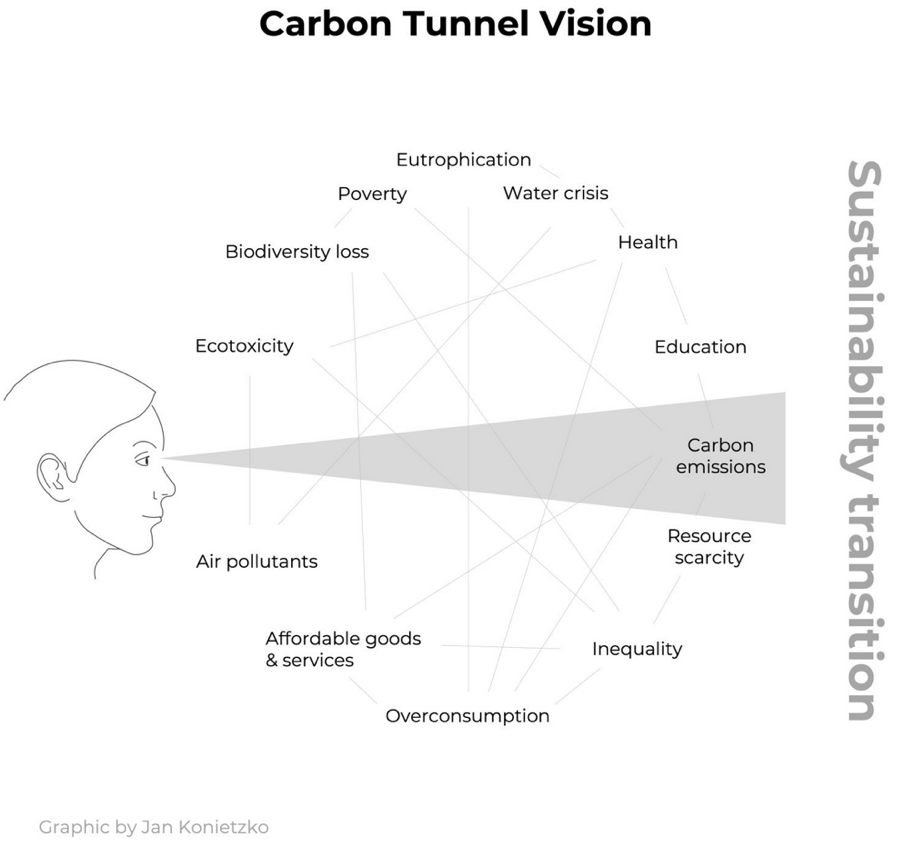
This feels very overwhelming, of course. Do we have to look everywhere, solve everything, all at once? Carbon tunnel vision is so much more relaxing: it feels like something specific, something well-defined that you can work on and see the numbers go in the right direction. That doesn’t happen with many of these other issues.
Of course, neither of those visions is true. Just working on your emissions will not solve all the related problems. Delaying action for much longer will make those problems only bigger and even more unmanageable. But those additional issues don’t come in a package: you can pick and choose, you can prioritise and make your medium- and long-term plans. No one is asking you to solve them all at once; just to look at them honestly and act decidedly where you can.
The light at the end of the tunnel
Here’s the good news: as we learn how to widen the focus and learn of the consequences of the climate crisis all kinds of opportunities present themselves, giving us the chance to be part of the solution. Because we might find that we’re better positioned, and have more power, to remediate or even solve other aspects beyond our carbon footprint.
As a sector, or as a chain, or even as a single hotel, having our emissions more or less under control means that we’re not contributing to future problems, and that’s fantastic. But we still have to deal with the consequences of all emissions in the past, which are still affecting us and the world around us. Many of those consequences are social in nature. Most are fixable. A few of them are certainly within our reach as a sector, so there’s plenty of work to do to advance towards becoming a really sustainable sector.
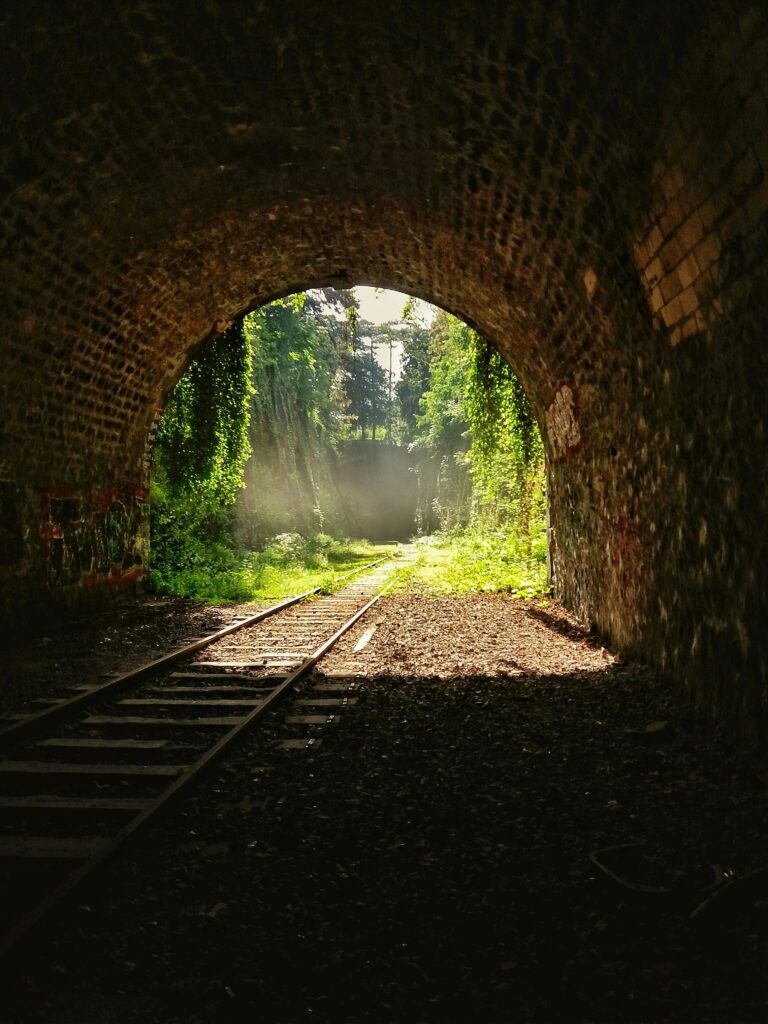
That’s why ESG encompasses much more than a carbon footprint, and much more than the purely environmental aspects. And that’s why a company with a low carbon footprint still has a large role to play as soon as it starts looking beyond the carbon tunnel. Because the light at the end of that tunnel is not scary; it’s not an oncoming train. If only we dare to look, we may find the light comes from a clear blue sky.